
Next business day delivery
Tracked with 2 hour delivery window
30 Day return policy
No Quibble, full refund or replacement
Up to 5 year warranty
With a Next Business Day Guarantee

Pure IT Refurbished Carbon Reduction Plan
Publication date: August 2024
Commitment to achieving Net Zero
pure IT is committed to achieving Net Zero emissions in Scope 1 and 2 by
2035, with Scope 3 net Zero by 2050.
Baseline Emissions Footprint
Baseline emissions are a record of the greenhouse gases that have been produced in the past and were produced prior to the introduction of any strategies to reduce emissions. Baseline emissions are the reference point against which emissions reduction can be measured.
Baseline Year: 2023
Additional Details relating to the Baseline Emissions calculations.
Base Year:
We have fixed a base year of January 2023 to December 2023. Every year our systems have become more accurate at recording the exact quantities of each part bought and their source origins. We used 2023 as it is the most accurate full year to date we have for setting a base line.
Baseline year emissions:
EMISSIONS
TOTAL (tCO2e)
Scope 1
4.4 tCO2e
Scope 2
6.7 tCO2e
Scope 3
(Included Sources)
262 tCO2e
- Transport and handling of refurbished parts and materials
purchased. - Transport of remanufactured devices to customers
- Manufacturing of new parts and materials purchased
- Business travel
- Employee commuting
- Business Waste
Total Emissions
273.1 tCO2e
Carbon Offset in 2023
356 tCO2e
Current Emissions Reporting
(To be completed at the end of 2024)
Baseline Year: 2024
EMISSIONS
TOTAL (tCO2e)
Scope 1
XX
Scope 2
XX
Scope 3
(Included Sources)
XX
Total Emissions
XX
Emissions reduction targets
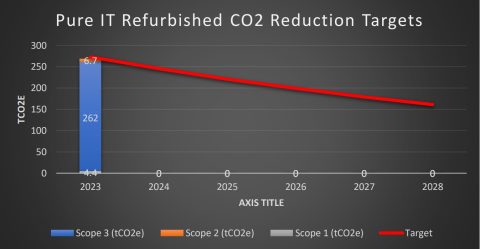
As this is our first year of recording carbon emissions, we currently have no historical data to demonstrate a reduction in emissions. However, we have established baseline measurements for Scope 1, 2, and 3 emissions, which will be used as a reference point for tracking our progress. Our reduction initiatives over the next three years aim to make measurable reductions, which will be recorded and reported annually to ensure transparency and accountability. These targets align with our commitment to achieving sustainable operations and minimizing our carbon footprint.
Progress against these targets will be presented in the graph below:
Carbon Reduction Projects
Scope 1 Initiatives
- Vehicle Fleet Transformation: We will replace all company diesel and petrol vehicles with hybrid or electric models. This shift will reduce our direct emissions by around 1.3 tCO2e from fuel use and contribute to cleaner air quality.
- Energy Efficiency in Heating: We plan to fit an air-source heat pump to reduce emissions associated with heating our facilities, moving towards a more efficient and low-carbon solution. We expect this to reduce emissions by 3.2 tCO2e
Scope 2 Initiatives
- Sourcing 100% Renewable Electricity: We will continue to source our electricity from 100% REGO-backed renewable energy sources. This ensures that our operations are powered by green electricity, significantly lowering our indirect emissions.
Scope 3 Initiatives
- Material Efficiency in Remanufacturing: We aim to reduce the use of new parts in our remanufacturing process by increasing in-house repair capabilities. This will decrease our emissions associated with the production and transportation of new components. Over the next 5 years we aim to reduce this by 50% equating to about 25 tCO2e
Year 1: Over the next year we aim to reduce this by 10% equating to about 5 tCO2e
Year 2: In year 2 aim to reduce this by a further 10% equating to about 5 tCO2e
Year 3: In year 3 aim to reduce this by a further 20% equating to about 10 tCO2e - Reduced Air Freight in Supply Chain: By adopting a more proactive purchasing strategy, we will reduce the reliance on air freight for parts and materials. This will minimize emissions related to long-distance, high-carbon transportation and optimize the logistics of incoming goods. Over the next 3 years we aim to reduce this by 80% equating to about 6.7 tCO2e
Year 1: Over the next year we aim to reduce this by 20% equating to about 1.68 tCO2e
Year 2: In year 2, we aim to reduce this by a further 20% equating to about 1.68 tCO2e
Year 3: In year 3, we aim to reduce this by a further 40% equating to about 3.35 tCO2e - Sustainable Packaging: We are committed to implementing lower-energy packaging materials to reduce emissions from packaging production and improve recyclability.
- Waste Reduction and Recycling: Our goal is to achieve 100% recycling of non-reusable materials and identify opportunities to reuse more of our business waste. This will decrease the carbon footprint from waste disposal and contribute to a circular economy.
- Reducing Employee Commuting Emissions: We will incentivize car-sharing, promote the Cycle to Work scheme, and subsidize public transport to reduce emissions from employee commuting. Over the next 5 years we aim to reduce this by 50% equating to about 10 tCO2e
Year 1: Over the next year we aim to reduce this by 10% equating to about 2 tCO2e
Year 2: In year 2, we aim to reduce this by a further 10% equating to about 2 tCO2e
Year 3: In year 3, we aim to reduce this by a further 10% equating to about 2 tCO2e
Continuous Improvement and Future Measures
As we move forward, we will monitor the impact of these initiatives and continue to explore further opportunities for carbon reduction. These efforts will align with best practices for environmental management and support our overall goal of reducing our carbon footprint across all scopes.
By implementing these initiatives, we aim to make measurable progress in reducing our greenhouse gas emissions, contributing to our sustainability goals, and supporting the global effort to mitigate climate change.
Declaration and Sign Off
This Carbon Reduction Plan has been completed in accordance with PPN 06/21 and associated guidance and reporting standard for Carbon Reduction Plans.
Emissions have been reported and recorded in accordance with the published reporting standard for Carbon Reduction Plans and the GHG Reporting Protocol corporate standard1 and uses the appropriate Government emission conversion factors for greenhouse gas company reporting2.
Scope 1 and Scope 2 emissions have been reported in accordance with SECR requirements, and the required subset of Scope 3 emissions have been reported in accordance with the published reporting standard for Carbon Reduction Plans and the Corporate Value Chain (Scope 3) Standard3.
This Carbon Reduction Plan has been reviewed and signed off by the board of directors (or equivalent management body).
Our Customers and Case Studies